
.jpg)
Isadora Taam
User Research & Strategy
Ephemeral.ai case study
UX Team of one challenge - final project at Experience Haus
CLIENT
Ephemeral.ai is a software startup company (SaaS) that helps brands track influencers' Instagram stories performance of content produced in collaboration with them, in a marketing effort.
The tool gets access to the data once influencers authenticate with it via Facebook. It mines and presents the metrics on a dashboard, making it easier for clients to track the content's performance.
BRIEF
A way of making influencers authenticate organically with the platform via Facebook. Their goal was to ultimately build an "influencer database" from which clients could pick influencers, better informed by those data.
PROCESS: DESIGN AS STRATEGY
To scan over the content, you can click on each section:
-
Stakeholder interview
-
Competitors analysis
-
User research
-
Affinity mapping
-
Opportunities
-
New product Concept
-
Getting to know the user
-
Conceptual Sketching
-
Low fidelity Wireframing
-
High fidelity Wireframing
Research
Stakeholder interviews
Goal
I met with Ephemeral.ai's CEO. Our first meeting was a 60 minute in-depth interview. My goal was to understand their business strategies short to long terms, resources, constraints, possible assumptions about the market and audience, and how they got to that brief.
Main Takeaways
-
Their main goal is help clients save time.
-
They have limited human resources. The ones they have as well as some assets are not being leveraged. Ephemeral.ai's CEO is a data scientist and they have access to extensive amount of users' data that is not been used.
-
Room for research & strategy: they are open for new solutions and new customer segments - such as creating a new tool for, finding out the most relevant audience to cater for etc.
Competitors analysis
Goal
At this stage I only researched tools/businesses in the Influencer Marketing market. My goal was to get insights on possible opportunities by understanding the problems competitors were solving; the customer segments they were catering for; and types technologies/ digital solutions they had developed.
Main Takeaways
-
The market is saturated with tools trying to solve the problem Ephemeral.ai is trying to solve, in a similar way: a platform that helps brands discover, manage campaigns and track metrics; and influencers to showcase their work and be contacted by brands.
-
Most tools target brands and influencers but give them different journeys. Branding and Communication is conflicting, at most of them.
-
The tools that target either brands or influencers seem more consistent.
User research
Goal
I interviewed both influencers and brands sides: 4 influencers and 4 marketing managers, marketing freelancers and business owners taking care of their marketing. My goal was to understand which audience most needed our help, and to search for opportunities to develop a digital solution with the resources Ephemeral.ai offers.
Main Takeaways
Influencers
-
None of them tried or would try a "marketplace platform". They grew their fan base organically and because of that, brands approach them - not the other way around.
-
They only promote brands they relate to or admire. Remaining authentic to their audience is the most important thing to them.
-
They consider themselves "creative". They are on Instagram to express themselves and inspire others - not to make a life out of it.
-
They prefer to be approached via email. They ay it feels "professional".
-
They reply to brands they know or have a quick feeling they are aligned with their style, due to the huge amount of email they get daily.
Brands
-
The ones that have tried such tools, didn't like it. They didn't finding influencers they wanted on it, and said the tool didn't help them communicate, so they switched to email/ text after the "discover" phase.
-
Most struggle on getting replies from influencers.
-
Most have struggle communicating their ideas to influencers.
-
Most were disappointed with metrics of their campaigns.
-
They don't set up campaign goals before contacting influencers.
Visualizing the data: Affinity Mapping
Below, the most insightful quotes from participants separated by theme:
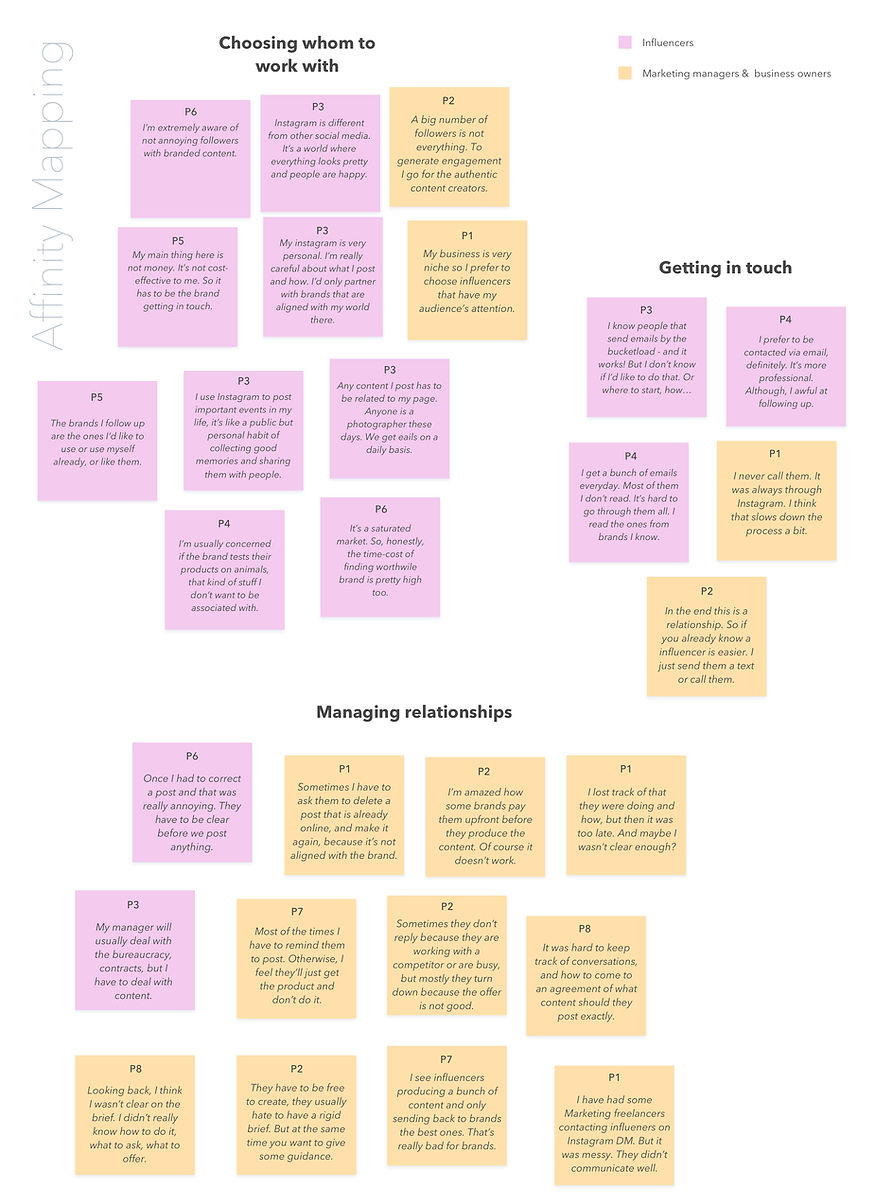
Summary
-
Brands want to work with influencers that produce authentic content, that will generate organic engagement with their audience.
-
Those influencers are not willing to compromise their authenticity for products or money: they will partner with brands they identify with.
-
Those influencers receive tons of emails daily and it is hard for brands to get those influencers' attention.
-
Many brands need help planning and communicating a campaign well before contacting influencers so they get more compliance from them.
Reframing the Strategy
Opportunities
Clients that most need help are business owners and marketing managers with planning and communicating their brands and campaigns better, so influencers they want to work with will reply to them.
New product's concept: designing to bring business value
A tool to help clients set the right campaign goals, assist them on how to search for the right influencers on Instagram, and how to pitch their campaign to them via email.
1. Competitive Advantages
-
it makes influencers that matter to our clients authenticate with the platform
-
it targets the "brand-side", but it can help a wide range, from startup owners to marketing managers
-
blue ocean strategy: its innovative approach sets Ephemeral.ai apart from competitors
2. Customer Segment Target
Marketing managers, freelancers and business owners (brand-side).
Using data from interviews and secondary research, I build a Persona and their Journey Map.
-
Persona 1: our customer sub-segment that most need help in solving the problem
-
Customer Journey Map: step-by-step on how they try to solve the problem now

Prototype, Test & Iterate
Sketching: Paper wireframes
Tool: Paper & pen :)
Goal: Quick and affordable, I used paper prototyping to get feedback on navigation, but specially on the amount of friction the flow had by asking users to input data in the stage: "create new campaign".

Main page

1. Open landing page from email reminder to start building campaign

9. See results
Main page
Low-fidelity Prototyping: Digital Wireframe
Tool: Figma
Goal: I ran usability tests with 5 possible users and colleagues. I got valuable feedback on interaction in each step, which was taken into consideration when going into high-fidelity prototype/mock up phase.
Feedback:
High-fidelity prototyping: Mock up
Tools:
Goal:
Takeaways: